Many Interests, No Hegemons
Can Anyone Stop Another Ethiopian-Eritrean War?
With a shift in the dynamics of the war in Gaza, media attention has drifted back to the reprise of a war with similarly deep roots: that between the Sudanese Armed Forces (SAF) and the Rapid Support Forces (RSF) in Darfur, where likely tens of thousands have died and more than 14 million displaced.
The Sudan conflict came on the heels of what was, without doubt, the most horrific conflict in East Africa of the 21st century—the 2020-2022 war between the federal government of Ethiopia and its Tigray province, that abuts the state of Eritrea. By some estimates, 700,000 people may have been killed in this war, in less than two years.
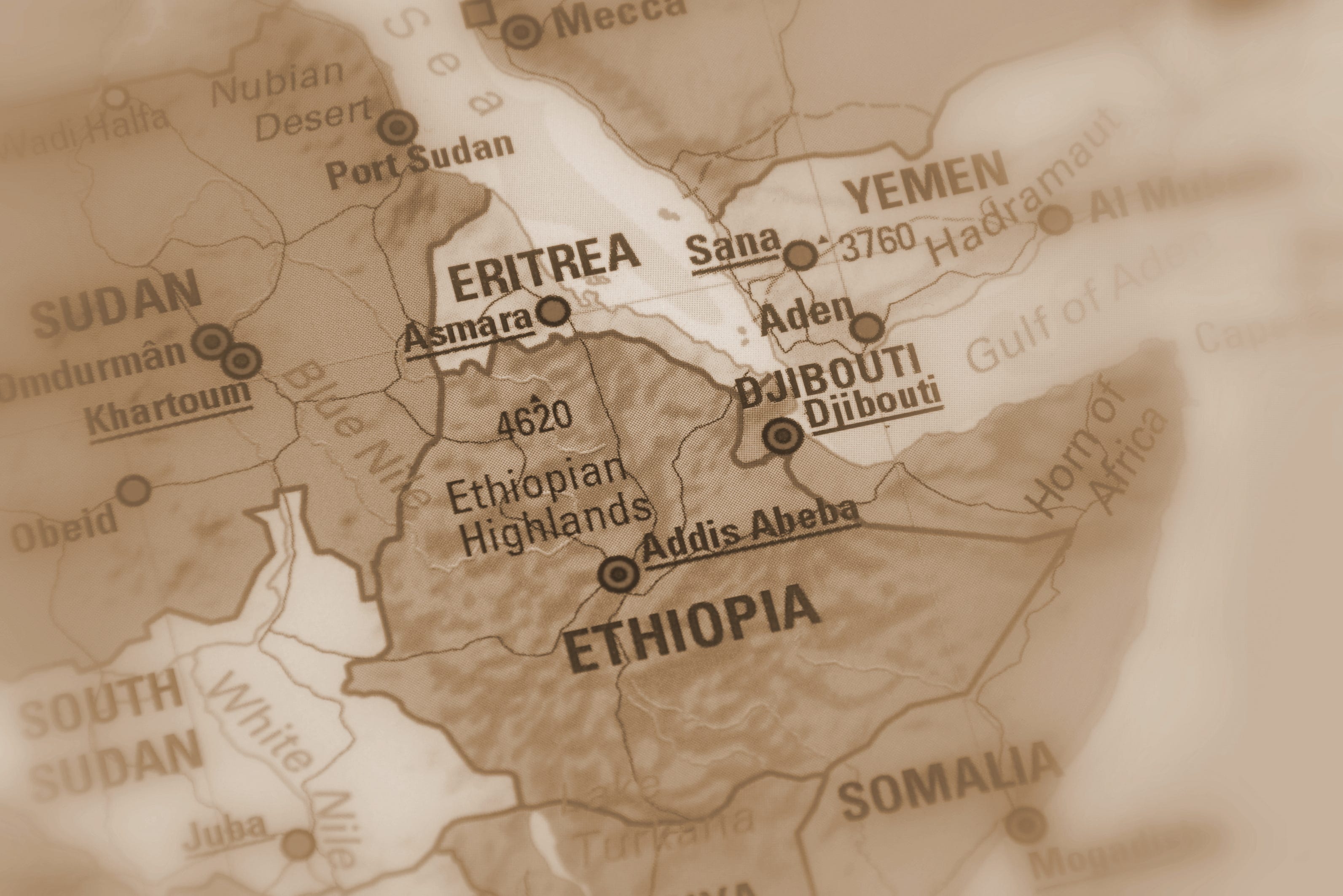
Now, as the Sudan conflict continues, there is growing concern over another potential conflagration, this one between Ethiopia and Eritrea, which won its independence from Ethiopia in 1993, after a 30-year struggle. Such a blowup has the potential to generate large-scale loss of life, and bring multiple Red Sea regional and external states into direct conflict.
The latest tension is ostensibly over Ethiopia’s asserted right to access to the Red Sea—which it does have now, via the ports of Berbera in Somaliland and Djibouti, and less easily, via Kenya and Sudan.
The irredentist Ethiopian claim to Assab is rooted in events dating back to the Italian establishment of the colony of Eritrea in 1890. But Abiy’s motive for directing Ethiopians’ attention to lost ports may have more to do with internal tensions than port access, as uprisings among Ethiopia’s ethnic Oromo and Amhara regions require a distraction—all the more so given Abiy’s (well-founded) belief that Eritrea is stoking those problems, and doing the same in the Tigray region.
The Roots of Conflict
The colonial powers, including Britain and France, had sought to dismember Eritrea and divide it between Sudan and Ethiopia, but Eritreans—now backed by their former colonizer, Italy—claimed a separate identity from Ethiopia and a desire for self-determination. Ethiopian Emperor Haile Selassie superseded the 1950 UN federation arrangement to annex Eritrea outright in 1962. With the collapse of Ethiopia’s Marxist-Leninist Derg regime in 1991, Eritrea held a referendum that resulted in independence in 1993. As part of that separation, Eritrea granted Ethiopia use of its ports at Assab and Massawa.
That cooperation ended in 1998, when a skirmish at the remote border town of Badme triggered a massive military buildup and war in which an estimated 70,000 to 100,000 were killed—the worst trench warfare since World War I. While the most intense fighting ended in 2000, it took two decades for the conflict to formally end in a 2018 peace agreement signed by Ethiopia’s Abiy Ahmed and Eritrea’s president Isaias Afwerki. In 2019 Abiy won the Nobel Prize for the achievement, which was mediated by the United Arab Emirates — with further help from the Saudis. Afwerki did not share in the prize, having been firmly cast by the international community as the leader of the “North Korea” of Africa.
From Tigray to Today
Briefly, Eritrea and Ethiopia were allied against the Tigray rebels, whose population is ethnically linked to Tigrinya-speaking populations in Eritrea and which harbored what Eritrea considered deserters from its forced-conscription army. The Pretoria Accords of November, 2022 that ended that conflict left Eritrea on the sidelines, and created unresolved issues that are partly behind the current tensions.
In the last months Abiy and his regime have been waging a fierce public relations campaign to suggest a historical Ethiopian claim on Assab—and a sovereign right to Red Sea access, based in part on the needs of Ethiopia’s 126 million people versus Eritrea’s 3.5 million. As observers have pointed out, neither country can afford a war right now—but Abiy may feel he cannot afford peace either, given the upheavals elsewhere in the country.
Meanwhile, the last conflict and the Pretoria Agreement created a split within the Tigrayan People’s Liberation Front (TPLF), pitting the Interim Regional Administration of Tigray (IRAT), initially led by Getachew Reda, against the traditional TPLF leadership under Debretsion Gebremichael. In October 2024, Debretsion’s faction announced Getachew’s removal in what the IRAT called a “public coup,” and by March 2025 armed forces loyal to Debretsion had seized control of government buildings in Mekelle. The Getachew faction has been loosely aligned with Abiy, while Debretsion’s faction leans toward Isaias. Due to its geography, and the degree to which Tigrayan population is heavily armed, any major conflict between Eritrea and Ethiopia would almost certainly go through Tigray, even if Ethiopia’s prize is Assab.
Regional Stakes
A war between Ethiopia and Eritrea would almost certainly draw other Red Sea and Gulf states into the fray. Saudi Arabia supports Eritrea as a stable partner on the western shore, buffering its Vision 2030 giga-projects on the eastern coast; the UAE has leaned more towards Ethiopia in recent years as a large and relatively dynamic—if still populous and poor—state near the Red Sea (a client for investment and port and logistics services), and a bulwark against Islamist extremism; Egypt backs Eritrea and Somalia against Ethiopia, whose Grand Ethiopian Renaissance Dam (GERD) Egypt considers an existential threat.
Eritrean government figures have been relatively restrained in the resulting war of words, but it is concerning that Abiy recently vowed to shake off Ethiopia’s “enemies” “one by one, like hair lice.” Several senior Ethiopian government officials have gone on record saying, in effect, that Assab is Ethiopia’s by historical right—a claim that would never survive an international arbitration.
An Unaffordable War
The last thing the Red Sea and international community needs is another hot conflict at the Bab el-Mandeb. The Yemeni Houthis used the Israel-Hamas conflict as an excuse to effectively blockade the Red Sea to 70% of shipping traffic for the better part of a year. The economic consequences of compound conflicts would be enormous, and the resulting casualties, refugees, migration, and heightened tensions would likely effects that could boomerang back on attempts to stabilize Israel-Palestine or any of the other Red Sea basin conflicts mentioned above. There are few mechanisms capable of defusing this conflict and few aid organizations capable of softening the blow to local populations.
Many Interests, No Hegemons
Despite its obvious and wide negative consequences, the latest unfolding tragedy in the Horn seems to have its own momentum, impervious to easy external resolution, through multilateral or unilateral mediation:
IGAD, the Intergovernmental Authority on Development based in Djibouti, counts both Ethiopia and Eritrea as members, but Eritrea has had a mixed relationship with the body. Eritrea also considers the African Union, based in Addis Ababa, biased in favor of Ethiopia. The United Nations has been hamstrung in the region by divisions in its own membership.
In previous years, the UAE and Saudi Arabia have helped mediate between Ethiopia and Eritrea. But today the two Gulf powers find themselves on opposite sides of conflicts on both shores of the Red Sea. In Yemen, the UAE was a lead Saudi ally in the war on the Houthis from 2015, but now backs the Southern Transitional Council (STC) against the Saudi-supported government in exile based in Aden, which the STC has recently seized, following dramatic gains in other parts of southern Yemen. In Sudan, the Saudis have backed the SAF—which also receives support from Iran and Russia—while the Emiratis have been accused of supporting the RSF. An Ethiopia-Eritrea war would likely lead to further space between Saudi Arabia and the UAE.
The Turks helped avert a war between Ethiopia and Somalia—the latter backed by Egypt—over a controversial 2024 memorandum that allegedly had Somaliland give a 50-year lease for Berbera and surrounding area to Ethiopia in exchange for Ethiopia’s recognition of the Somali autonomous region of Somaliland. But Turkish influence only extends so far.
It would appear to be squarely in the United States’ interest to avert an Ethiopia-Eritrea war. Tension between two of America’s deepest regional allies—Saudi Arabia and the UAE—puts Trump’s meta-framework for Middle East regional stability, the Abraham Accords, at risk, while creating opportunities for other powers, like Russia, to exploit new “cold war” dynamics to their own gain. This is already happening, as Sudan’s SAF recently offered Russia a long-awaited deal for a naval concession at Port Sudan.
The potential for mass casualties and dislocation adds to deep security and humanitarian concerns across the region. A war for Eritrea’s ports compounds Red Sea instability on the Yemen side, with further effects on international shipping. And the conflict could easily spill over into Djibouti, where the US and China both have a substantial military presence.